
In the construction of the aluminum formwork wall and column system, the waler is not a simple transverse reinforcement rod, but a key stress-bearing component in the wall formwork reinforcement system. It works together with the tie rods, pin-and-wedge sets, diagonal braces, and wall and column formwork panels to determine whether the wall formwork is stable during concrete placement, whether the wall thickness is controlled, whether the verticality meets the requirements, and the quality of the concrete after the formwork is removed.
For general contractors, aluminum formwork subcontractors, project technical leaders and overseas construction contractors, the focus of waler installation is not as simple as "installing it", but to make the position of the waler, the force of the tie rods, the formwork joints, the Yin and external corner constraints and the diagonal brace adjustment form a complete closed reinforcement system. CIEZN's aluminum formwork system covers cast-in-situ structural parts such as walls, columns, beams, slabs, stairs, balconies, door and window openings, etc. The installation of waler is an important part of whether the wall and column formwork system can be poured stably.
Aluminum formwork systems usually consist of panel systems, support systems, connection systems and reinforcement systems. The wall and column formwork panel is responsible for forming the concrete section, the pin-and-wedge sets are responsible for the connection between the formwork panels, the tie rods or flat ties are responsible for controlling the wall thickness and resisting lateral pressure, and the waler is responsible for converting local stress into continuous constraints to prevent local bulging, misalignment and deformation of the formwork.
During the wall concrete placement process, fresh concrete will exert lateral pressure on the formwork. If only a single panel and local connectors bear pressure, the wall is prone to problems such as formwork bulging, formwork displacement, out-of-square internal and external corners, and wall verticality deviations. The waler is arranged horizontally and continuously to improve the overall stiffness of the wall formwork, so that the clamping force of the tie rod can be more evenly transmitted to the formwork panel.
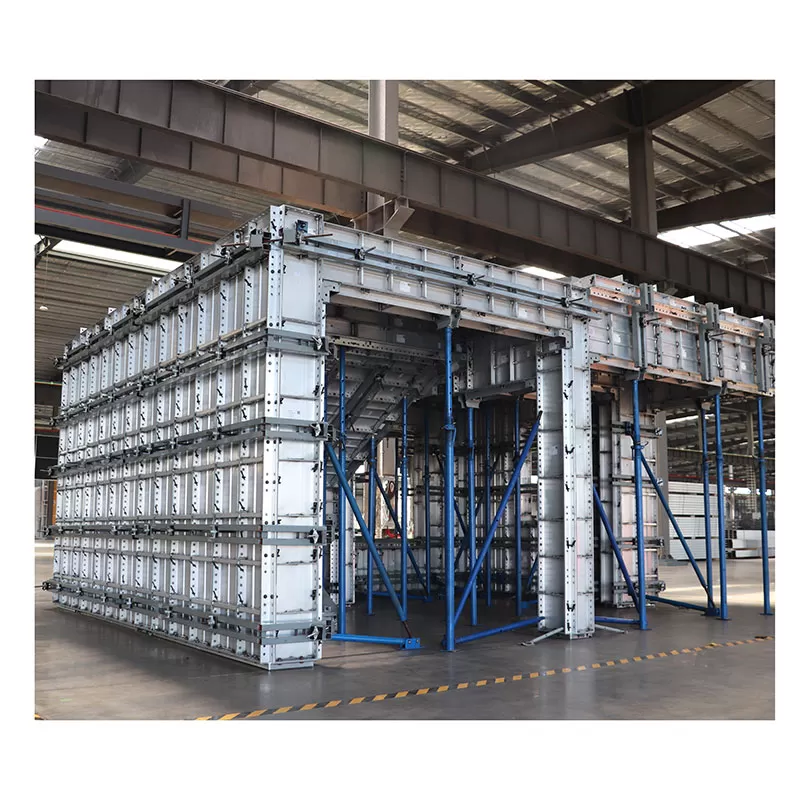
In the common Tie-Rod + Waler aluminum formwork reinforcement system, the tie rods, walers and diagonal braces are not three types of accessories used independently, but work together to complete the wall reinforcement and verticality control. The anti-tie rods mainly control the thickness of the wall and resist the outward lateral pressure on both sides of the formwork; the waler is responsible for distributing the reinforcement force in the horizontal direction and enhancing the overall stability of the wall; the diagonal braces are responsible for fine-tuning the verticality and lateral stability after the formwork is in place.
If you only tighten the tie rods and ignore the length and straightness of the walers, local stress concentration will easily occur on the formwork surface. If the waler is in the correct position but the diagonal braces are not adjusted properly, the overall verticality of the wall may still be deviated. Therefore, the waler installation must be checked simultaneously with the template correction, screw tightening, and diagonal brace adjustment.
| Check items | Technical points | Impact on construction quality |
|---|---|---|
| Wall and column formwork in place | Confirm that wall panels, column formwork, internal and external corner formwork, end panels and opening formwork have been installed according to numbers. | If the waler is installed before the formwork is in place, the subsequent adjustment space is small and it is easy to cause a localized forced contact. |
| pin-and-wedge connection | Check whether the pins and wedges at the adjacent formwork joints are complete, in the correct direction, and locked in place. | Loose connections will cause misaligned joints during pouring and affect the flatness of the wall. |
| Tie-rod hole positions | Confirm that the tie-rod hole matches the waler hole position or the clamp position, and that the casing, gasket, and nut are fully prepared. | Hole position deviation will cause the screw to be diagonally pulled, weakening the wall thickness control and reinforcement effect. |
| Waler specification and straightness | Check whether the square tube or rectangular hollow waler is deformed, bent, or cracked, and whether the end connection is reliable. | If the waler installation itself is not straight, it will be directly transmitted to the template surface, affecting the verticality and flatness. |
| Bracing and adjusting rod | Check the fixed point of the diagonal support base, the adjusting screw rod, the connecting pin and the reserved adjustment stroke. | Insufficient diagonal braces will cause springback after correction and reduce the stability of the wall during the pouring stage. |
Before installing the waler, the preliminary installation of wall panels, internal corners, external corners, end boards, K boards, door and window opening templates and other parts should be completed according to the aluminum mold detailed design drawings. The bottom of the wall formwork should be cleaned, and the positioning lines, control lines and elevation lines should be reviewed and completed. The formwork panels should be reliably connected through pins to avoid large-scale adjustment of the panel seams after the waler is installed.
When using a tie rod system, the screws should be installed according to the designed hole positions and used in conjunction with casings, washers and nuts. The screw should be kept as horizontal as possible, and no obvious diagonal pull should occur. When using the Flat-Tie flat tie system, the flat ties, flat tie sleeves and supporting connectors should be installed according to the designed position, and attention should be paid to the cutting and waterproofing requirements after the mold is removed later.
The first waler is usually installed from the lower part of the wall. During installation, the waler should fit against the outside of the formwork and be reliably connected to the tie rods, clamps or hooks. The nut can be tightened initially, and it is not advisable to tighten it all at once. First ensure that the waler installation is continuous, straight and without obvious misalignment before installing the next waler installation.
When the wall height is large, multiple walers should be installed from bottom to top according to the designed spacing. The lower concrete side pressure is greater, and the distance between the waler and the cross-tie rod usually needs to be more carefully controlled. At the internal and external corners, wall ends, opening edges, connecting wall positions and short limb wall positions, it is necessary to focus on checking whether the waler forms effective constraints to avoid corner expansion and end formwork displacement.
After the waler is installed, the tie rod nuts should be tightened in sections, layers, and symmetrically. A common mistake during construction is that a certain side or a certain row of nuts is overtightened at one time, resulting in local concave formwork or wall thickness deviation. The correct approach is to perform initial tightening as a whole, then use a line hammer, ruler or laser to check the verticality and flatness of the wall, and finally perform re-tightening.
The diagonal braces should be reliably connected to the wall formwork, and the base should be fixed on the structural surface or pre-embedded fixed points. Use the diagonal brace adjustment screw to push and pull to adjust the wall formwork to meet the design verticality requirements. When making corrections, you should not only look at the verticality of a single point, but also make a comprehensive judgment based on the length of the wall, the edges of the door and window openings, the squareness of internal and external corners, and the intersection of adjacent walls.
One of the advantages of aluminum formwork construction is the high forming accuracy, but only if the installation stage is well controlled. Wall verticality control should be carried out throughout the initial installation of formwork, reinforcement of walers, adjustment of diagonal braces, review before pouring and inspection of the concrete placement, rather than just one test before pouring.
There are two common systems for aluminum formwork wall reinforcement: Flat-Tie flat tie system and Tie-Rod tie rod system. The pull-tab system accessories are lighter, and the spacing between diagonal braces can be more flexible, making it easier to fine-tune the verticality of the wall; no obvious pull holes will be left on the wall after the formwork is removed, and subsequent repairs and waterproofing treatments are less stressful. The counter-tie rod system usually consists of counter-tie rods, walers and diagonal braces. It has strong overall reinforcement capabilities and is suitable for construction scenarios that require strong wall stability. However, after the formwork is removed, the tensile holes need to be sealed and waterproofed as required.
Which system to choose should be comprehensively judged based on the project structure form, wall height, turnover times, construction habits, concrete placement methods, waterproofing requirements and the proficiency of overseas workers. For purchasers, they should not only look at the price of a single set of formwork, but also evaluate the completeness of accessories, on-site training, in-depth design capabilities and construction quality control support.
| question | Possible reasons | Handling suggestions |
|---|---|---|
| Local formwork bulging | The distance between the walers is too large, the nuts are not tightened, the pins are missing, or the pouring speed is too fast. | Review the layout of the waler and screws, inspect the weak areas, and control the layers during pouring. |
| Wall verticality deviation | Insufficient adjustment of the diagonal braces, uneven waler alignment and uneven positioning of the bottom of the formwork. | First check the line position, then adjust the diagonal brace, loosen the local nut and recalibrate if necessary. |
| Wall thickness is inconsistent | The tie rod is diagonally pulled, the casing length is wrong, and the nut is unevenly tightened. | Check the casing and wall thickness control parts, and tighten them symmetrically according to the layers to avoid hard pulling at a single point. |
| Internal and external corners are out of square | The corner formwork is not firmly connected, the waler is not extended in place, and the corner restraints are insufficient. | Strengthen the inspection of corner formwork pin-and-wedge sets, increase corner reinforcement, and review the squareness. |
| Risk of leakage at tie holes after formwork stripping | The holes in the Tie-Rod system were not properly processed after the mold was removed. | The cross-drawing holes should be sealed according to the requirements of waterproof nodes, and the exterior walls of the basement should be inspected and accepted. |
For overseas contractors and material purchasers, waler systems should not be purchased casually as ordinary accessories. The waler specification, wall thickness, material, hole position, connection method, and matching with the tie system will all affect the on-site installation efficiency and concrete forming quality. A high-quality aluminum formwork solution should also provide in-depth formwork design, accessories list, installation guidance, on-site training and post-turnover maintenance suggestions.
The CIEZN aluminum formwork product system includes wall and column formwork, floor formwork, basement formwork, Flat Tie system, pin-and-wedge sets, steel props and other supporting components, which can be systematically configured around typical floors, basements, podiums and complex structures. For the wall and column areas, the purchaser should focus on confirming whether the wall formwork panels, walers, tie systems, diagonal braces, pins and internal and external corner joints are matched, rather than comparing quotations based on individual accessories.
The core of the waler installation of aluminum formwork is to transform the wall formwork from "single panel assembly" into an "overall stress-bearing system". Only when the waler, tie rods, diagonal braces, pin-and-wedge sets and formwork detailing are in place, can wall reinforcement and verticality control be implemented stably, and a concrete structure with accurate dimensions, good surface quality and fewer downstream repairs can be obtained.
The waler is mainly used to enhance the overall stiffness of the wall formwork, transmit the clamping force of the tie rod evenly in the horizontal direction, and prevent mold drums, running molds, wall thickness deviations and out-of-control verticality during concrete placement.
It is not recommended to screw it all at once. It should be initially tightened as a whole, and the line position, verticality and flatness should be reviewed before layering and symmetrical tightening. Unilateral or local over-tightening can easily cause concave formwork, wall thickness deviation or local deformation.
Both work together. The waler is responsible for improving the overall lateral stiffness of the wall formwork, the tie rods control the wall thickness and lateral pressure, and the diagonal braces are responsible for fine-tuning the overall verticality and lateral stability of the formwork. You cannot rely solely on one component to complete all corrections.
The Flat-Tie system has lighter accessories and more flexible spacing between diagonal braces, making it easier to finely adjust the verticality; the Tie-Rod system forms stronger overall reinforcement through tie rods, walers and diagonal braces. The specific selection should be judged based on the wall height, structural form, waterproofing requirements and construction habits.
The straightness of the waler, the tightening status of the nuts, the integrity of the pins and wedges, the fixation of the diagonal braces, the squareness of the inner and outer angles, the reinforcement of the door and window openings, the wall thickness control parts and the positioning of the bottom of the formwork should be checked. Special personnel should also be arranged to inspect during the concrete placement.
Phone: +8618711321769
Email: alame.vicky@gmail.com
WhatsApp: +8615400055585
Address:No.88, Shuntian Avenue, Xiangyin District, Xiangjiang New District Hunan Province

 EN
EN
 RU
RU
 AR
AR
 ES
ES