
When contractors evaluate an aluminium formwork system, the first attention usually goes to wall panels, slab panels, beam panels, column panels, and the overall structural layout. However, on real construction sites, the performance of the entire system is often determined by smaller components that are easy to underestimate: aluminium formwork accessories.
These accessories are not optional add-ons. They are the connection, locking, supporting, alignment, spacing, and load-resisting parts that allow aluminium panels to work as a complete, safe, fast, and reusable forming system. Without the correct accessories, even high-quality aluminium formwork panels may face poor alignment, grout leakage, slow installation, concrete bulging, unsafe pouring, and high replacement costs.
A complete aluminium formwork system is therefore not defined by panels alone. It is defined by how well panels, pins, wedges, ties, props, brackets, supports, and positioning parts work together.
This complete guide explains the essential aluminium formwork accessories, their functions, common specifications, application positions, selection criteria, and how overseas contractors can build a jobsite-ready accessory package for efficient and repeatable construction.
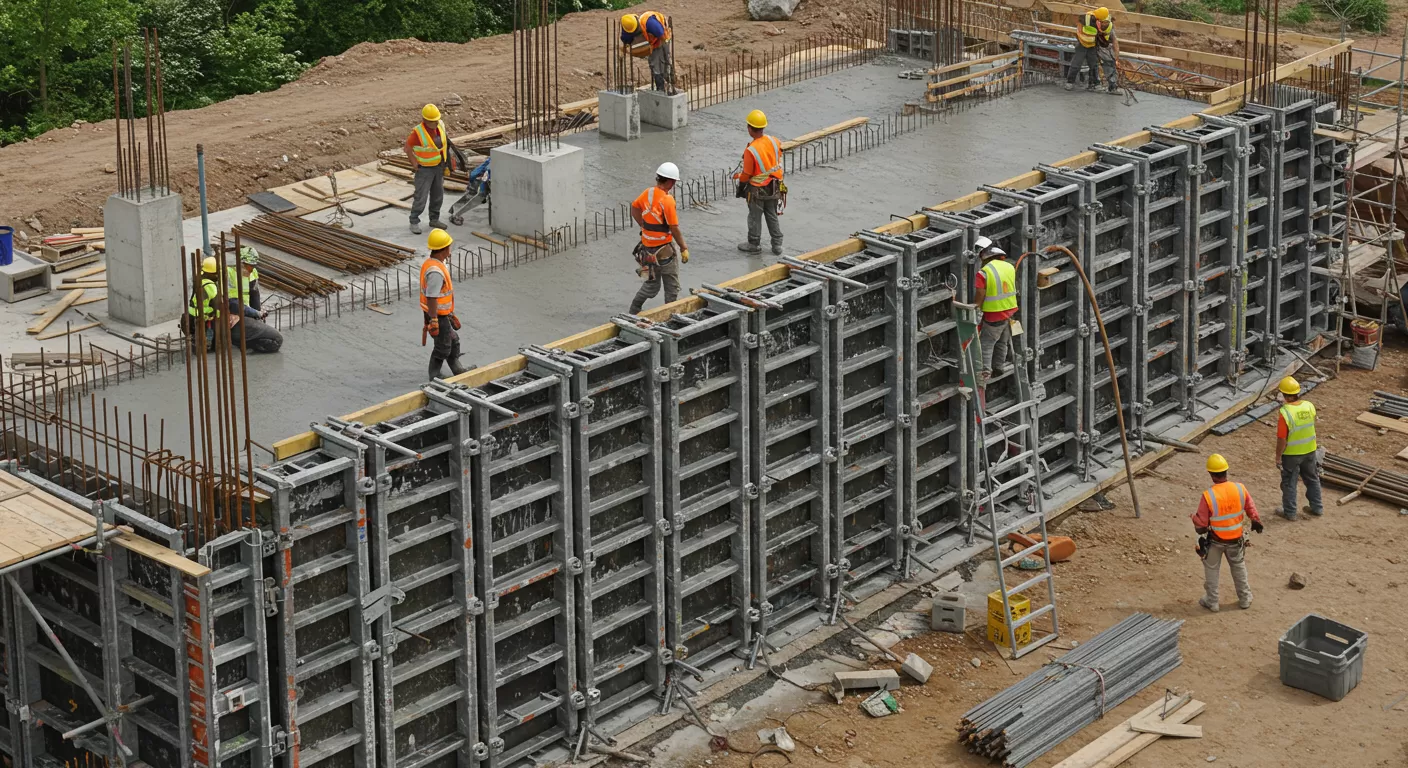
Aluminium formwork is designed for fast-cycle construction, especially in high-rise residential buildings, apartments, hotels, commercial buildings, and repetitive concrete structures. The system performs well only when every component fits accurately and transfers force correctly.
Accessories are responsible for several key functions:
In practice, many aluminium formwork problems are not caused by panel quality alone. They are caused by incomplete accessory packages, mismatched connectors, low-strength ties, insufficient supports, or accessories that are not compatible with the panel design.
For a deeper explanation of the risks caused by incomplete accessory systems, read:
Why Aluminium Formwork Systems Fail Without Proper Accessories
The table below summarizes the most common and essential aluminium formwork accessories used in a complete system. Specifications may vary depending on project design, wall thickness, slab height, concrete pressure, and supplier standards.
| Accessory Category | Main Accessories | Typical Function | Application Position |
|---|---|---|---|
| Connection Accessories | Pins, wedges, connecting pins, locking parts | Lock panels together and maintain joint tightness | Wall panels, slab panels, beam panels, column panels |
| Spacing & Tie Accessories | Flat ties, wall ties, tie rods, tie sleeves, tie plates | Control wall thickness and resist lateral pressure | Wall formwork, column formwork, shear walls |
| Support Accessories | Steel props, adjustable props, back supports, brackets | Support vertical and horizontal loads | Slab formwork, beam bottom, wall alignment areas |
| Alignment Accessories | Alignment clamps, waller systems, kicker braces, push-pull props | Keep formwork straight, plumb, and level | Walls, columns, large panel areas |
| Corner & Transition Accessories | Internal corners, external corners, corner angles, end plates | Handle corner connections and non-standard transitions | Wall corners, beam-wall joints, slab edges |
| Slab & Beam Accessories | Drop heads, early stripping heads, beam supports, prop heads | Support slab and beam panels and enable faster dismantling | Slabs, beams, floor systems |
| Fixing & Reinforcement Accessories | Washers, wing nuts, anchor parts, bolts, plates | Strengthen load transfer and locking stability | Tie systems, support connections, edge areas |
| Stripping & Reuse Accessories | Stripping tools, lifting hooks, replacement pins, repair parts | Improve dismantling speed and lifecycle management | Repeated-use areas, maintenance zones |
| Safety & Working Accessories | Working platforms, guardrail brackets, access brackets | Improve jobsite safety and worker access | Exterior walls, slab edges, high-rise construction |
This accessory list can be used as a procurement checklist before shipment. A reliable supplier should provide not only panels, but also a complete accessory package based on the project layout and construction sequence.
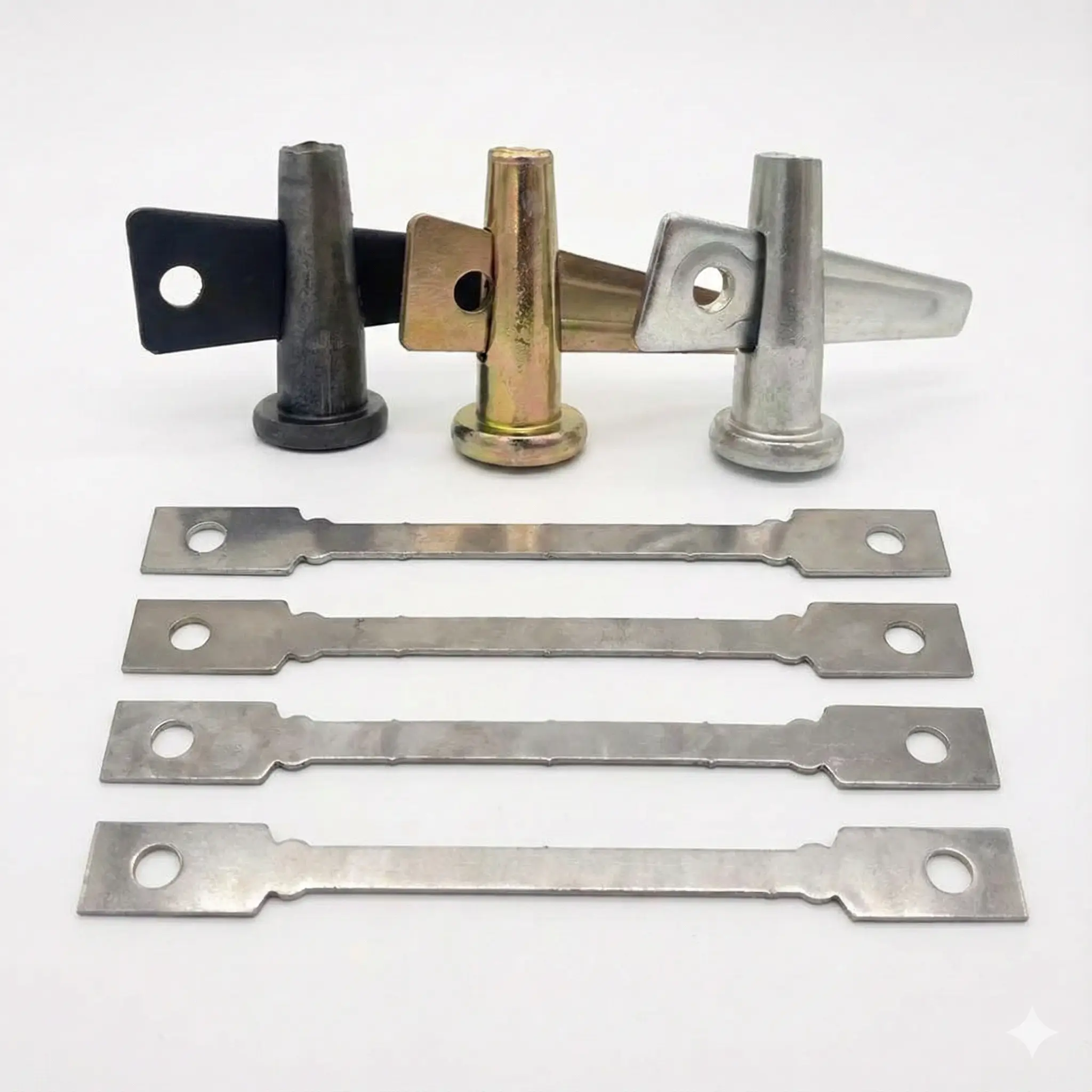
Connection accessories are the first and most important group in an aluminium formwork system. They transform individual panels into a stable forming structure.
Pins and wedges are used to connect adjacent formwork panels through aligned holes. The pin passes through the panel holes, and the wedge locks the pin in place. This simple mechanism allows workers to assemble and dismantle panels quickly without complex tools.
| Item | Common Material | Typical Use | Key Requirement |
|---|---|---|---|
| Pin | Steel or aluminium alloy | Panel connection | Straightness, strength, easy insertion |
| Wedge | Steel or aluminium alloy | Locking pin and panel joint | High clamping force, wear resistance |
| Long Pin | Steel | Thicker joint or special connection | Correct length and anti-deformation |
| Locking Part | Steel or alloy | Special panel fixing | Compatibility with panel hole design |
A reliable pin and wedge system improves joint tightness, reduces panel movement, and helps prevent grout leakage during concrete pouring.
For more details about this critical connection mechanism, read:
Why a Reliable Pin–Wedge–Tie System Matters in Performance and Lifecycle of Aluminum Formwork
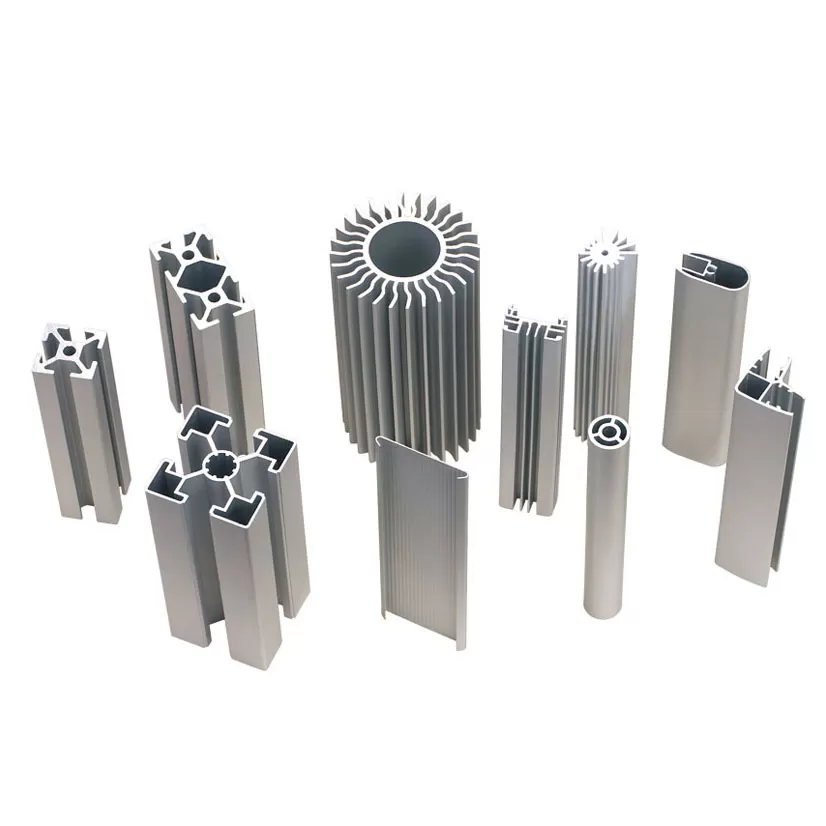
Tie accessories are essential for wall formwork and vertical concrete structures. Their main purpose is to maintain the correct distance between opposite panels and resist the lateral pressure of fresh concrete.
During pouring, fresh concrete creates lateral pressure on the formwork panels. If this pressure is not properly controlled, the panels may bulge, move, open at joints, or create uneven wall thickness.
Tie accessories help:
| Accessory | Typical Application | Selection Focus |
|---|---|---|
| Flat Tie | Standard wall formwork | Wall thickness, tensile strength, compatibility |
| Wall Tie | Wall and column systems | Load resistance and spacing accuracy |
| Tie Rod | Heavy-duty wall or special structure | Diameter, thread quality, tensile strength |
| Wing Nut | Tie rod locking | Thread match, locking strength |
| Washer / Plate | Load distribution | Thickness, surface contact area |
Poor-quality or mismatched ties can directly cause wall deformation, dimensional error, or even formwork failure. For this reason, tie accessories should always be selected according to wall thickness, concrete pouring height, pressure conditions, and panel design.
Support accessories keep the aluminium formwork system stable under vertical and horizontal loads. They are especially important for slab formwork, beam formwork, and tall wall areas.
Support accessories help transfer loads safely to the ground or supporting structure. They maintain the position of slab panels, beam panels, and wall panels during installation, concrete pouring, and curing.
They are used to:
| Accessory | Application Position | Key Selection Factor |
|---|---|---|
| Steel Prop | Slab and beam support | Load capacity, adjustable height, stability |
| Prop Head | Top of support prop | Fit with slab or beam panel |
| Push-Pull Prop | Wall and column alignment | Adjustable range and locking strength |
| Bracket | Wall or edge support | Bearing capacity and installation position |
| Back Support | Large wall panels | Rigidity and pressure resistance |
If support accessories are insufficient or incorrectly arranged, the system may suffer from sagging slabs, tilted walls, unsafe working conditions, or slow construction cycles.
Alignment accessories are used to ensure the finished concrete structure meets dimensional and surface quality requirements. They help control verticality, flatness, and panel positioning.
Even when panels are connected properly, large wall areas or tall structures may require additional alignment control. Alignment accessories reduce the risk of deviation caused by vibration, pressure, installation error, or repeated use of panels.
They help improve:
| Accessory | Main Purpose | Recommended Use Case |
|---|---|---|
| Alignment Clamp | Joint and panel alignment | Panel-to-panel straightness control |
| Waler | Large surface reinforcement | Long wall and high-pressure areas |
| Push-Pull Prop | Vertical adjustment | Wall and column plumb correction |
| Kicker Brace | Bottom positioning | Wall base and corner control |
Accurate alignment accessories reduce rework, improve concrete finish, and help contractors maintain predictable floor-to-floor construction cycles.
Corners, edges, beam-wall joints, and transition areas are often the most difficult parts of an aluminium formwork project. These areas require dedicated accessories to ensure tight connections and accurate geometry.
Corner and transition accessories help formwork adapt to architectural details that standard panels cannot handle alone. They improve joint accuracy and prevent leakage in complex areas.
They are used to:
| Accessory | Application | Selection Focus |
|---|---|---|
| Internal Corner | Inside wall corners | Angle accuracy and hole matching |
| External Corner | Outside wall corners | Joint strength and edge finish |
| End Plate | Formwork closing area | Dimension match and leakage control |
| Filler Panel | Non-standard gap adjustment | Width, thickness, and connection hole position |
Well-designed corner accessories reduce the need for on-site improvisation and help ensure that the final concrete corners are sharp, accurate, and clean.
Slab and beam systems require accessories that support vertical loads and allow efficient dismantling. In many high-rise projects, slab accessories directly influence the construction cycle speed.
These accessories support horizontal formwork and help contractors strip part of the formwork earlier while keeping the necessary support in place. This can improve material turnover and reduce the number of panels required on site.
They help with:
| Accessory | Main Function | Application Position |
|---|---|---|
| Drop Head | Early stripping support | Slab formwork |
| Prop Head | Load transfer to prop | Slab and beam support |
| Beam Support | Beam bottom stability | Beam formwork |
| Slab Bracket | Edge or local support | Slab edge areas |
For contractors working on repetitive floors, slab and beam accessories are highly valuable because they support faster turnover and more predictable floor cycle planning.
Fixing and reinforcement accessories are used to improve connection strength, distribute loads, and reinforce high-pressure or high-risk areas.
These accessories may look simple, but they are important for load transfer and pressure distribution. They help prevent local deformation, loosening, and damage around connection points.
They are used to:
| Accessory | Function | Selection Requirement |
|---|---|---|
| Wing Nut | Lock tie rod | Thread accuracy and strength |
| Washer | Spread load | Adequate size and thickness |
| Plate | Reinforce contact area | Flatness and bearing strength |
| Bolt | Fix components | Grade, length, and corrosion resistance |
These parts should not be replaced randomly with incompatible local components. Even small dimensional differences can affect locking force and site safety.
Aluminium formwork is valued for its repeated use. To maintain this advantage, contractors need accessories that support efficient stripping, cleaning, repair, and replacement.
These accessories improve the long-term use of the formwork system. They help workers dismantle panels safely, reduce damage, organize parts, and keep the system ready for the next cycle.
They help with:
| Accessory | Purpose | Value for Contractors |
|---|---|---|
| Stripping Tool | Remove panels safely | Reduces panel damage |
| Lifting Hook | Move panels efficiently | Improves handling safety |
| Replacement Pin | Replace worn parts | Maintains installation speed |
| Storage Rack | Organize accessories | Reduces loss and confusion |
For large projects, accessory management is not a minor detail. It directly affects daily productivity, labor cost, and system reuse value.
Safety accessories are especially important for high-rise construction and external wall applications. They protect workers and improve access during installation, pouring, and dismantling.
Safety accessories provide stable working areas and reduce fall risks during construction. They also support safe movement around formwork systems.
They help improve:
| Accessory | Application | Selection Focus |
|---|---|---|
| Platform Bracket | Worker access | Load capacity and fixing safety |
| Guardrail Bracket | Edge protection | Height, strength, and stability |
| Access Bracket | Movement support | Compatibility with site layout |
| Climbing Part | High-rise formwork | System integration and safety factor |
Safety accessories should always be included in the overall formwork planning instead of being added as an afterthought.
Selecting accessories is not only about quantity. It is about compatibility, strength, site efficiency, and lifecycle cost.
Pins, wedges, ties, brackets, and supports must match the panel hole positions, panel thickness, profile standard, and assembly method. Any mismatch can slow installation or create safety risks.
For a more detailed explanation of system compatibility, read:
Ensuring System Compatibility: How to Avoid Hidden Risks in Aluminum Formwork Projects
Tie accessories should be selected according to wall thickness, concrete height, pouring speed, and expected pressure.
Important factors include:
Props, brackets, and support accessories must be able to handle slab, beam, and construction loads safely.
Contractors should confirm:
Standardized accessories make replacement easier, reduce downtime, and improve long-term project management.
Benefits include:
Before shipping, buyers should request a detailed accessory packing list. This helps avoid missing parts after containers arrive on site.
The list should include:
The following checklist can help contractors, distributors, and project buyers evaluate whether the accessory package is complete.
| Checklist Item | Why It Matters | Status |
|---|---|---|
| Pins and wedges included in sufficient quantity | Ensures fast panel connection | To be checked |
| Flat ties or wall ties match wall thickness | Controls wall dimension and pressure | To be checked |
| Props and support heads match slab height | Ensures slab and beam support safety | To be checked |
| Corner accessories match drawings | Prevents leakage and corner defects | To be checked |
| Alignment accessories included | Improves verticality and flatness | To be checked |
| Spare accessories provided | Reduces downtime from loss or damage | To be checked |
| Accessories match panel hole positions | Ensures system compatibility | To be checked |
| Packing list is complete | Prevents missing parts after delivery | To be checked |
| Accessories are labeled by zone or floor | Improves site installation speed | To be checked |
| Maintenance and replacement plan prepared | Extends system lifecycle | To be checked |
A complete checklist reduces on-site uncertainty and helps contractors start installation faster after delivery.
Even one missing accessory type can create a chain reaction on site. The most common problems include:
When pins, wedges, or locking parts are missing, workers may need to search for substitutes or wait for replacements. This delays the entire floor cycle.
Poor joint locking or incompatible corner accessories can cause gaps between panels, leading to slurry leakage and honeycombing.
Weak or mismatched ties may fail to resist concrete pressure, resulting in uneven wall thickness or panel deformation.
Without sufficient alignment clamps, walers, or push-pull props, walls and columns may become out of plumb.
Insufficient supports, weak brackets, or unstable tie systems can increase the risk of formwork movement or failure during pouring.
Low-quality accessories may bend, wear, corrode, or loosen quickly, causing frequent replacement and higher hidden costs.
A complete aluminium formwork accessory package should be designed according to the project drawing and construction method. However, a typical complete package should include the following groups:
| Accessory Group | Recommended Items | Purpose |
|---|---|---|
| Basic Connection Kit | Pins, wedges, long pins, locking pieces | Panel assembly and joint locking |
| Wall Formwork Kit | Flat ties, wall ties, washers, wing nuts, tie plates | Wall thickness and pressure control |
| Slab Support Kit | Steel props, prop heads, drop heads, slab supports | Slab load support and early stripping |
| Beam Formwork Kit | Beam supports, beam side clamps, prop heads | Beam forming and support |
| Alignment Kit | Push-pull props, walers, alignment clamps, braces | Verticality and straightness control |
| Corner Kit | Internal corners, external corners, corner connectors, end plates | Corner and edge forming |
| Safety Kit | Platform brackets, guardrail brackets, access accessories | Worker safety and external access |
| Spare Parts Kit | Extra pins, wedges, ties, nuts, washers | Replacement and emergency use |
| Maintenance Kit | Stripping tools, cleaning tools, storage racks | Reuse and lifecycle management |
This package helps ensure that the system is not only shipped as a set of panels, but delivered as a complete construction-ready solution.
For overseas contractors, compatibility is especially important because replacement parts may not be immediately available on site. If the accessories do not match the panels, the project may face long delays and additional costs.
Using accessories from different suppliers without technical verification can create hidden risks. A one-stop aluminium formwork supplier can reduce these risks by providing panels, accessories, supports, and drawings as one integrated system.
A well-designed accessory system improves productivity in several ways:
In high-rise construction, even small time savings per floor can create major schedule and labor cost advantages across the full project.
Accessory management is often overlooked, but it has a direct impact on project efficiency.
Good accessory management helps protect the investment value of the aluminium formwork system.
Choosing a complete aluminium formwork accessory system from one supplier offers several advantages:
For contractors and distributors, this means fewer site problems and more predictable project execution.
A supplier should be able to provide:
A complete system supplier does not simply sell components. It helps the contractor build a workable, compatible, and reusable construction solution.
Aluminium formwork accessories may be small compared with panels, but they determine whether the full system can perform safely, efficiently, and repeatedly on site.
Pins and wedges connect the panels. Ties control pressure and wall thickness. Props and brackets support loads. Alignment accessories maintain accuracy. Corner parts solve complex transitions. Safety accessories protect workers. Maintenance accessories extend the lifecycle of the whole system.
For contractors, developers, and formwork distributors, the key lesson is clear: a complete aluminium formwork system must include a complete, compatible, and well-managed accessory package.
When accessories are selected correctly, the system delivers faster installation, safer pouring, better concrete quality, lower rework, and higher reuse value. When they are missing or mismatched, even premium aluminium panels cannot achieve their expected performance.
A professional aluminium formwork project starts not only with strong panels, but with the right accessories working together as one complete system.
Phone: +8618711321769
Email: alame.vicky@gmail.com
WhatsApp: +8615400055585
Address:No.88, Shuntian Avenue, Xiangyin District, Xiangjiang New District Hunan Province

 EN
EN
 RU
RU
 AR
AR
 ES
ES