
Modern construction projects are always looking for ways to provide faster, cheaper and more quality buildings. For the owners and procurement teams of the project, the formwork systems will determine the speed of construction, the efficiency of the labor and the control of the overall costs the most. The traditional timber and steel formwork systems often cannot meet these requirements at scale. Timber easily distorts, incurs high material loss and few reuse cycles, while steel systems require more labor and thus increase dependency on cranes.
On the other hand, the aluminum formwork systems evolved as the answer to the problem of industrializing and standardizing construction methods. The industrial aluminum profiles used in these systems are the ones that guarantee the integrity of the structure, the precision of measurement, and the long-term reusability. This article targets construction project buyers, engineers, and decision-makers who need to better comprehend the role of aluminum profiles in the modern formwork systems and their increasing preference for international projects.
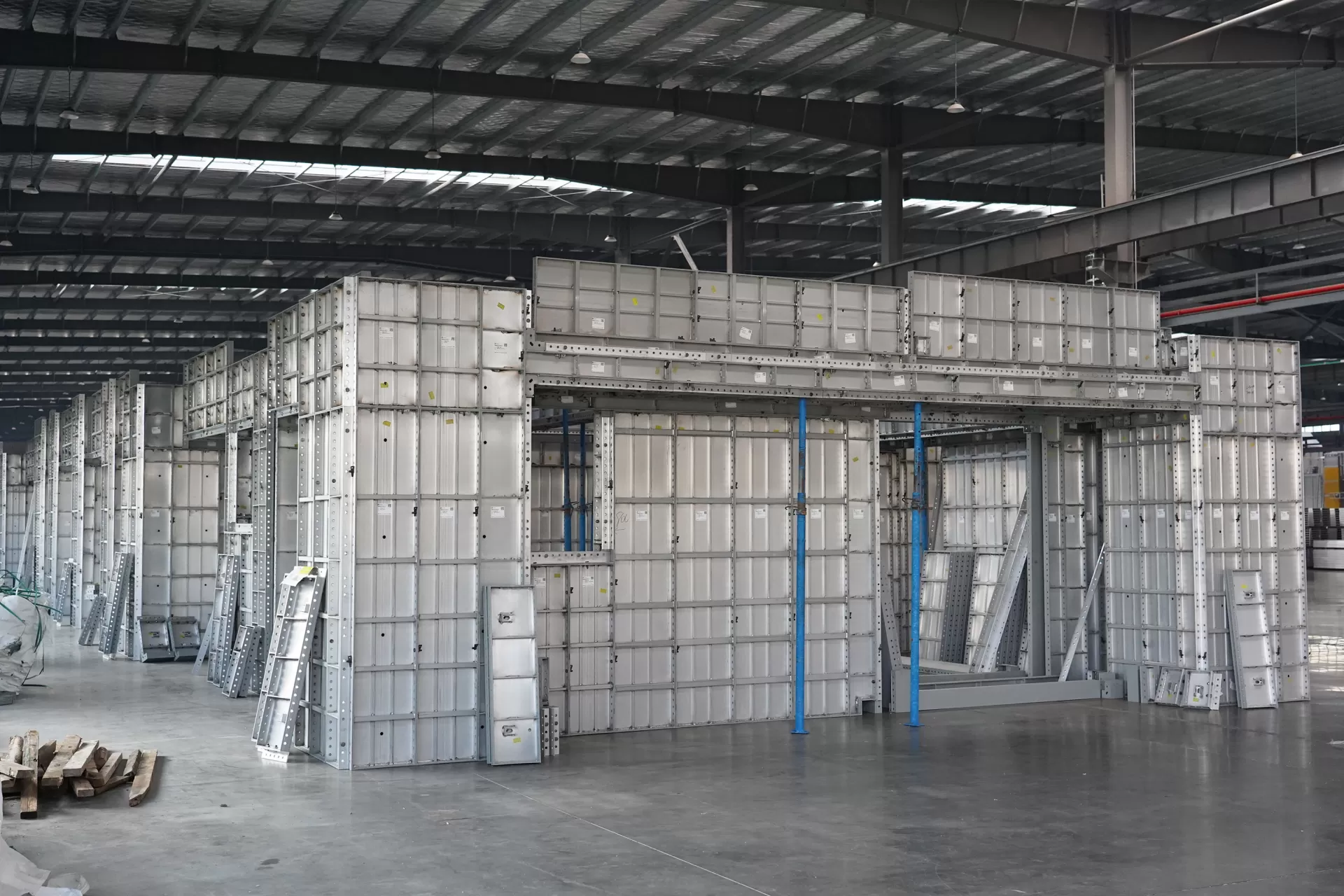
Precision-extruded industrial aluminium profiles are structural components specifically designed to provide support, framework, and connections in aluminium formwork systems. These profiles are not only high-quality but also specifically made for the construction industry where strength-to-weight ratio, durability, and dimensional stability are the main requirements, unlike generic aluminium sections.
Most of the aluminium formwork materials are based on the using of 6061 and 6063 alloys, which provide a very good balance between mechanical strength and resistance to corrosion. These alloys keep their reliability under repeated loading and unloading cycles while maintaining their straightness and shape stability.
The main physical properties of industrial aluminium profiles are low weight, high structural strength, corrosion resistance, and excellent machinability. These properties make it possible to use aluminium profiles for formwork repetitively in the most demanding construction environments, such as high-rise residential buildings and large commercial developments.
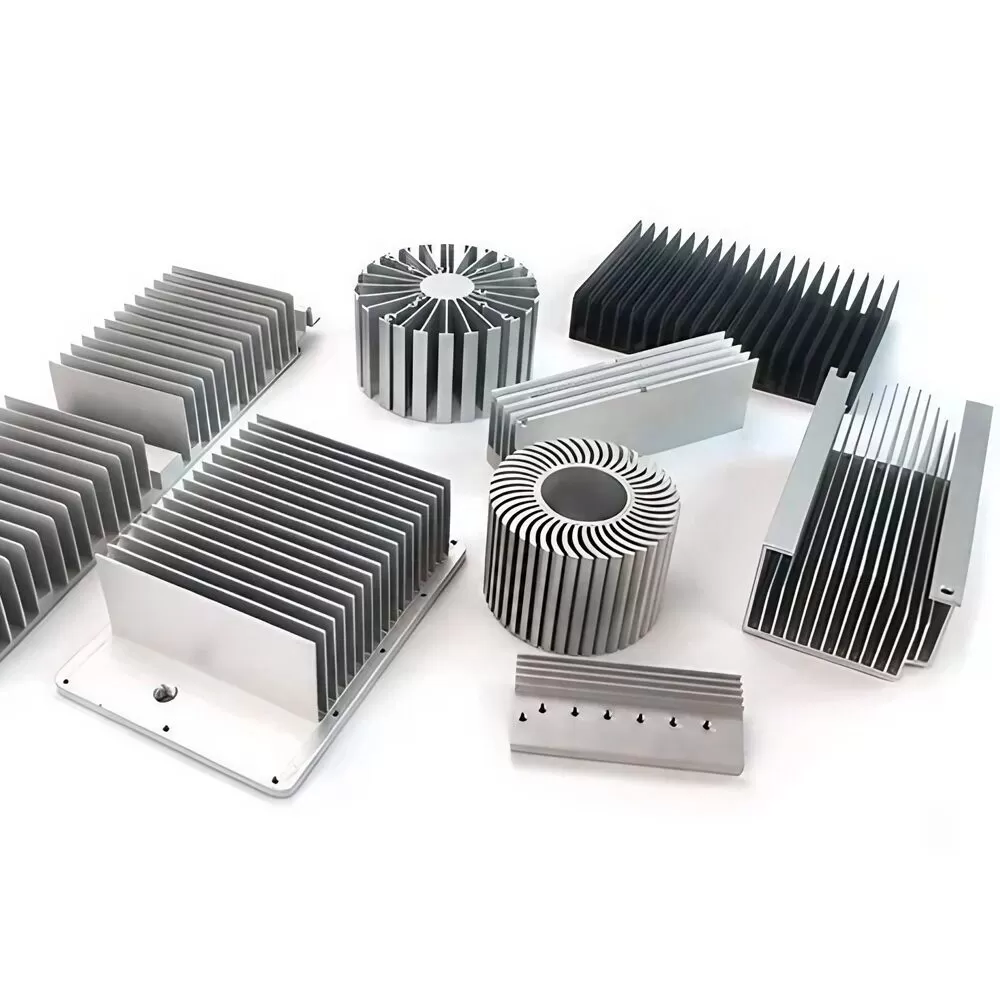
The performance of an aluminium formwork system depends not only on the alloy grade but also on the cross-section design of the profile. A well-designed profile section improves stiffness, load distribution, connection accuracy, and repeated assembly performance.
Common profile cross-section types used in formwork-related applications include:
H-beam and I-beam profiles: Used for structural support, beams, joists, and load-bearing members.
U-channel profiles: Used for edge protection, panel framing, and guiding components.
T-slot profiles: Used for modular connections, adjustable fixtures, and industrial framing.
C-shaped profiles: Used for frame reinforcement and side support.
Square or rectangular hollow profiles: Used for lightweight structural frames, supports, and bracing.
Customized extrusion profiles: Designed according to project drawings, load requirements, and connection details. CIEZN has much experience in customized aluminum extrusion profile, welcome contact us for your customized profile.
Material selection is a key factor in the performance of industrial aluminium profiles. For formwork systems, the profile must provide strength, dimensional stability, corrosion resistance, and reliable machining performance.
Common aluminium alloy options include:
For construction formwork and aluminium beam applications, 6061 aluminium alloy is commonly selected because it provides a strong balance of mechanical strength, processing performance, and durability. Some aluminium beam products can be supplied in tempers such as T3–T8, depending on the required strength and application.
Surface treatment is also important for long-term performance and appearance. Common surface treatment options include:
The final material grade, temper, surface treatment, wall thickness, and profile length should be selected according to the project drawings, load requirements, working environment, and expected reuse cycles.
In a complete aluminium formwork system, industrial aluminium profiles are not used as isolated components. They work together with panels, beams, frames, connectors, and accessories to create a stable and reusable forming system.
In wall panels, slab panels, and column panels, aluminium profiles are commonly used as:
Well-designed panel profiles help maintain dimensional accuracy during repeated use and reduce concrete leakage at joints.
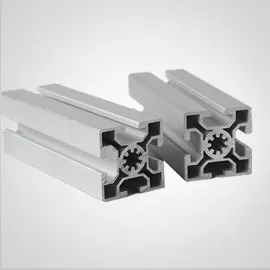
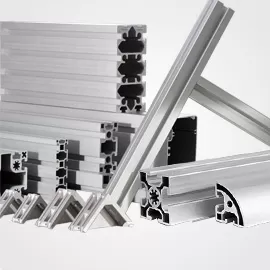
Aluminium beam profiles are used to support slab decking, wall systems, and temporary construction loads. Common beam-type profiles include I-beams, H-beams, and customized structural extrusion profiles.
These profiles are especially important in:
Compared with steel beams, aluminium beam profiles offer easier handling, lower self-weight, and better corrosion resistance, which is valuable for fast-cycle construction projects.
Industrial aluminium profiles are also used to build modular frames for formwork systems. These frames help connect panels into complete wall, slab, beam, or column units.
In frame applications, profiles must provide:
This is why profile design, alloy selection, wall thickness, and machining accuracy are all critical to the final performance of the formwork system.
In aluminium formwork systems, various profile types have individual structural and functional roles. Besides, beams and structural profiles usually talk about slab and wall support, whereas edge and reinforcement profiles strengthen the panel and guard the susceptible parts.
Aluminium profiles are frequently designed and manufactured to meet accurate dimensional and load requirements for projects that have unconventional shapes or special building needs. The use of these custom-made solutions allows the contractor to improve the performance of the formwork without hindering the process.
Many formwork projects require aluminium profiles that match specific panel dimensions, connection holes, beam lengths, or frame structures. For this reason, industrial aluminium profiles are often supplied with secondary processing services before delivery.
Common processing options include:
By supplying profiles according to drawings and project specifications, manufacturers can help contractors reduce on-site cutting, improve installation accuracy, and shorten preparation time.
For a detailed overview of available profile categories, you can explore Industrial Aluminium Profiles for Formwork Systems at Aluminum-profile
Using aluminium profiles in industrial applications leads to a significant decrease in system weight in comparison to steel. This results in less crane usage, a decrease in the intensity of labor, and a faster allowance for manual handling. The speed of installation gets substantially better, especially in the case of high-rise buildings with tight schedules.
Aluminium formwork materials can usually be reused 200–300 times if they are well maintained. This feature of high reusability has a direct effect on the control of long-term project costs, making aluminium profiles a cost-effective investment for all projects in the neighborhood.
The exact dimensions given by the precision extrusion process are the reason for the improvement in the quality of the concrete surface. That is why walls and floors are often requiring little or no secondary plastering, thus the time and the amount of finishing materials are reduced.
The industrial aluminium profiles are suitable for use in humid, coastal, or high-temperature areas. Their naturally low susceptibility to corrosion means that there will be no performance problems in these areas where steel systems will need more protection.
Aluminium formwork systems that are supported by industrial aluminium profiles do not only cost money, but also bring serious benefits and improvements in productivity from the point of view of procurement. The speedy mounting results in shorter cycles of construction and a faster turnover of floors from one to another. The waste of material is very much reduced when compared with timber systems, and the upkeep is almost non-existent. Over the lifecycle of a project portfolio, the use of aluminium profiles leads to a reduction in costs related to storage, frequency of replacement and dependency on labor. These factors are the ones that result in a stronger return on investment and also make cost planning easier for large-scale construction programs.
Every construction project has its specific needs for formwork. Industrial aluminium profiles can be tailored accordingly to fit any situation, whether it is a residential high-rise, a commercial complex, or an infrastructure project. The variations in profile cross-sections, wall thickness, and connection features are possible via the development of extrusion molds.
The customization based on individual projects has the limitations of order quantity, the complexity of the design, and the time frame of the project. To assist overseas projects with particular technical needs, CIEZN provide adaptable minimum order quantities.
Quality consistency is critical for formwork performance. Reliable suppliers control dimensional tolerance, straightness, and surface quality throughout the manufacturing process. Surface treatments such as anodizing or coating improve durability under construction conditions.
For overseas buyers, material traceability, inspection records, and compliance with international standards are essential. Reference standards from organizations such as ISO help ensure consistency and reliability across global projects.
Industrial aluminium profiles play a central role in the performance of modern aluminium formwork systems. For overseas construction project buyers, they offer a balanced solution combining efficiency, durability, and long-term cost control. By understanding how these profiles function and how to source them correctly, procurement teams can make informed decisions that support project success across multiple construction cycles.
CIEZN provides standard and customized industrial aluminium profiles for construction formwork, aluminium beams, structural frames, and modular formwork systems. Our team can support profile design, material selection, surface treatment, precision cutting, drilling, punching, and export delivery according to your project drawings.
Send your profile drawing or formwork requirement for quotation:
They offer a better strength-to-weight ratio, faster installation, and lower lifecycle costs.
Typically between 200 and 300 cycles, depending on usage and maintenance.
Yes, they are widely used in high-rise residential and commercial buildings.
Yes, extrusion molds allow dimensional and structural customization.
Their corrosion resistance makes them suitable for humid and coastal regions.
Phone: +8618711321769
Email: alame.vicky@gmail.com
WhatsApp: +8615400055585
Address:No.88, Shuntian Avenue, Xiangyin District, Xiangjiang New District Hunan Province

 EN
EN
 RU
RU
 AR
AR
 ES
ES