
Aluminum formwork is not acceptable simply because it can be assembled after delivery. What determines efficiency on later floors and the quality of the finished concrete is the first trial installation on the benchmark floor, commonly called the initial assembly. Its value lies in testing detailed drawings, factory trial assembly, site numbering, accessory compatibility, reinforcement coordination and embedded items under real construction conditions. The earlier a problem appears, the more stable the typical-floor cycle becomes. Releasing a defective first floor means repeating the same rework on every later floor.
For projects planning to use the CIEZN TECH aluminum formwork system, the benchmark-floor trial should examine more than installation speed. It must show whether drawing conversion, formwork closure, accessory matching and site-service response can support mass construction. In practical terms, the initial assembly must answer three questions: Are the drawings translated accurately into components? Does the system assemble smoothly? Have all conditions for typical-floor construction been closed out?
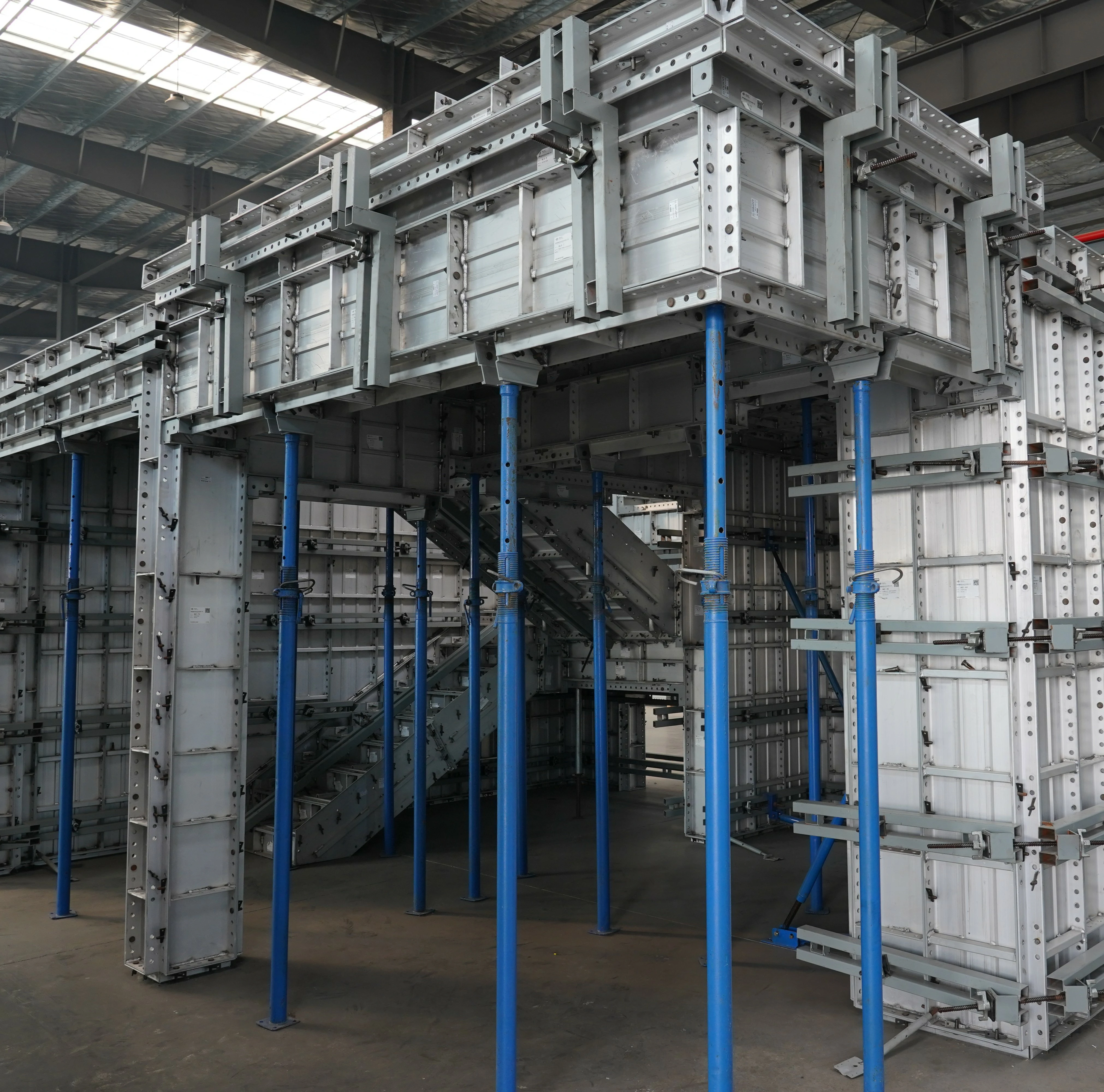
Initial assembly is not an opportunity for the crew to improvise; it is a physical verification of the detailed aluminum formwork design. Before installation, coordinate the architectural and structural drawings, MEP reservations and embedded items, secondary-structure boundaries, door and window openings, sunken slabs, upstands, stairs and junction details. Every wall, column, beam, slab, stair, bay window, opening, K panel, internal and external corner, and rebate must have a clear counterpart on the panel-layout drawings.
Dimensional conversion errors are easily overlooked. Aluminum formwork is a customized system, and a deviation of only a few millimeters can accumulate across wall, beam-side and slab panels until it produces an offset, an excessive joint or a displaced opening. Benchmark-floor checks should cover more than overall dimensions. Spot-check grid lines, wall thickness, floor-to-floor height, slab elevation, beam soffit elevation, clear opening dimensions, the distance from opening edges to grid lines, and closure between wall and slab panels.
Factory trial assembly and numbering are intended to reduce site modification and guesswork. During inquiry or technical briefing, ask the supplier to explain the numbering rule, packing-list format, zone-based packing method and identification system for shear-wall, beam, slab, stair, opening and irregular panels. A supplier such as CIEZN TECH, which provides trial assembly and a complete formwork system, can align numbering with the building, floor, apartment type and component category before the first installation so crews do not rely on memory.
During the trial, check that numbers are legible and orientations correct, that no location has duplicate or missing numbers, and that the packing list matches the delivered components. If the crew repeatedly searches by experience on the first floor, numbering, zoned storage or drawing presentation is not ready for mass construction. Typical floors depend on fast cycling; longer retrieval times increase the likelihood of incorrect installation and crude panel modification.
Wall and column aluminum formwork is the first priority during initial assembly. Internal walls, external walls, stop-end panels, internal and external corners, column panels and wall-column junctions must follow the panel sequence, without skipping positioning and alignment to save time. Check the wall control lines, the level of the panel base, joint tightness, complete installation of pins and wedges, and whether flat-tie or through-tie systems match the design wall thickness.
High-risk locations include short wall returns, door jambs, corner walls, external-wall K panels, sunken-slab edges, stairwells, lift shafts and service shafts. If the first floor shows panels that will not close, misaligned pin holes, out-of-square corners, walers that cannot continue through a junction or insufficient push-pull prop adjustment, return to the detailed drawings and fabrication dimensions. Do not enlarge holes or cut panels casually on site. Enlarged holes reduce reuse accuracy and are difficult to restore.
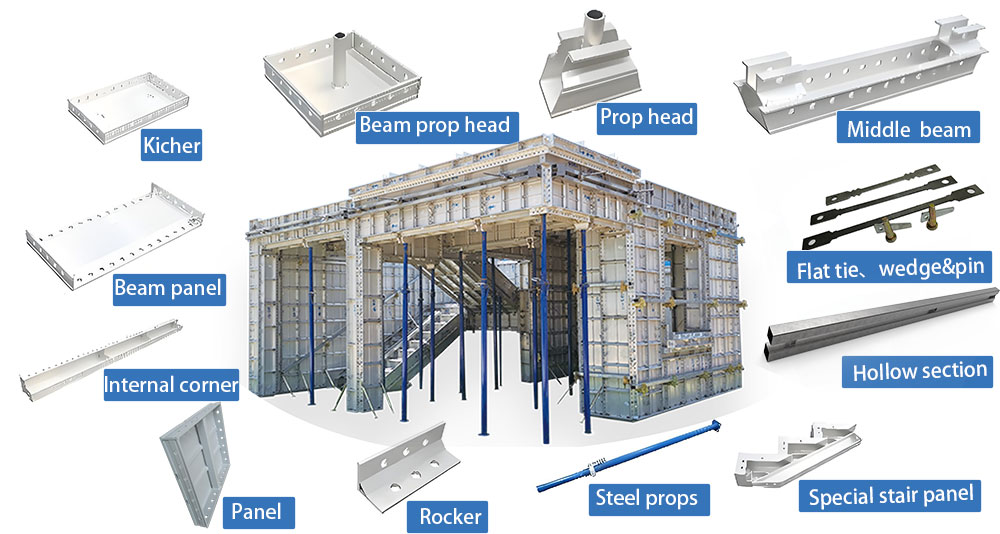
Beam and slab formwork is not complete merely because the deck is fully covered. The first trial must show that beam soffit and side panels, slab panels, early-striking heads, steel props, horizontal bracing and push-pull props form a continuous and stable support system. Prop spacing, verticality, adjustable-base extension, early-striking head positions and beam-to-slab joints must comply with the approved scheme.
If the support and panel systems do not match, concrete placement can cause bulging, deflection, grout leakage or loss of slab elevation. The trial should simulate the pre-pour load condition, checking for loose connections, panel-level differences, adequate beam-side reinforcement and strengthening around openings. On high-rise residential or repeated-layout projects, a stable first-floor beam and slab system is a prerequisite for moving toward a shorter typical-floor cycle.
System stability depends heavily on compatible accessories. Pins, wedges, ties, walers, push-pull props, wall ties, steel props, early-striking heads and corner connectors may appear to fit when their specifications differ, yet loosen or deform during casting. During the technical inquiry, procurement can ask CIEZN TECH for a complete schedule of panels, supports, connectors and aluminum formwork accessories, together with the replenishment method for common consumables. This prevents the first floor from relying on parts gathered from different sources.
Use an accessory checklist during initial assembly and record missing or incorrect components, hole mismatches, inconsistent specifications and substitutes. On repeated-cycle projects in particular, a temporary accessory solution on the first floor amplifies installation delays and safety risks on every later floor.
| Inspection item | Common initial-assembly problem | Mass-construction release point |
|---|---|---|
| Detailed drawings and physical components | Grid lines, openings and beam-slab junctions do not match | Update drawing-review records, change orders and panel-layout drawings together |
| Numbering and storage | Slow retrieval, duplicate numbers, omissions or confused orientation | Store and check lists by building, floor, apartment type and component |
| Wall and column assembly | Misaligned holes, out-of-square corners and leaking joints | Do not cut or enlarge holes casually; verify fabrication and detailed dimensions first |
| Beam, slab and supports | Props out of plumb, displaced early-striking heads and deck-level differences | Review the support system against the scheme and complete reinforcement inspection before casting |
| Accessory system | Pins, wedges, ties and walers of mixed specifications | Standardize components and replace shortages before releasing typical-floor work |
Initial assembly cannot be completed by carpenters or the aluminum formwork crew alone. Reinforcement, plumbing, electrical, MEP reservations and embedded items, climbing-frame and perimeter-protection teams should all participate in the benchmark review. Door and window openings, electrical boxes, sleeves, plumbing openings, air-conditioning holes, embedded railing items, external-wall bolt-hole treatment and structural-column connections can all create expensive rework when they clash with the formwork.
During the trial, review reinforcement fixing, cover control, embedded-item positioning and formwork closure together. If cover blocks prevent the panels from closing, or an embedded box clashes with a waler or tie, agree the adjustment on the first floor and write it back into the detailed drawings and site briefing.
The final stage of the benchmark trial is the pre-pour inspection. Check panel cleanliness, release-agent application, joint sealing, connector tightening, support reinforcement, access routes, pump-line arrangement, vibration paths and formwork-watch staffing. Concrete placement is not a static test: vibration, pumping impact and construction loads all test the quality of the initial assembly.
If the first floor shows grout leakage, bulging, offsets, wavy walls, slab-elevation errors or distorted openings, assign each defect to a specific cause: detailed dimensions, fabrication accuracy, installation sequence, missing accessories or poor casting practice. Mass construction should be released only when the cause is clear.
Do not rely on a verbal statement that large-scale work can begin after the initial assembly. The project team should produce a benchmark-floor inspection record containing, at minimum, an issue list, responsible persons, rectification photographs, reinspection results, updated drawing revisions, an accessory replenishment list, crew-briefing records and a recommended typical-floor cycle.
For procurement and the main contractor's technical department, the first assembly also reveals the supplier's engineering capability. Where the project needs detailed design, factory trial assembly, installation guidance, worker training, site problem response or secondary panel-design support, the first-floor trial can be defined as a service milestone in the inquiry: who attends the benchmark inspection, how quickly issues are reported, how drawings are revised and how missing parts are dispatched. In discussions with CIEZN TECH, this moves the quotation beyond panel price and onto project-delivery risk and engineering support.
A benchmark-floor trial determines whether an aluminum formwork system can move from drawings to the workface and then be repeated reliably across typical floors. A long issue list is not the problem. The problem is failing to record those issues, return them to the drawings, assign them to specific components and include them in crew briefings. A thorough first-floor trial is what makes later mass construction genuinely faster, more stable and more economical.
Phone: +8618711321769
Email: alame.vicky@gmail.com
WhatsApp: +8615400055585
Address:No.88, Shuntian Avenue, Xiangyin District, Xiangjiang New District Hunan Province

 EN
EN
 RU
RU
 AR
AR
 ES
ES